Bridging Mission and Capital: How Program Related Investments Empower Foundations
Overview
Foundations exist to tackle challenges that markets and governments overlook, such as funding research, advocacy, and providing vital services for those who need it most. Traditionally, this meant giving grants to those providing the services and growing the endowment capital base through conventional investments. But many foundations have become more strategic, applying tools such as Program Related Investments (PRIs) to make a difference.
Program Related Investments (PRIs) let foundations use their capital to drive real impact, going beyond what grants or market-rate investments can achieve. PRIs blend the best of both worlds: strategic investment and mission-driven philanthropy to amplify their reach and effectiveness.
What is a Program Related Investment (PRI)
PRIs fall under the category of charitable contributions, but unlike grants, they are structured with the expectation of return of capital.
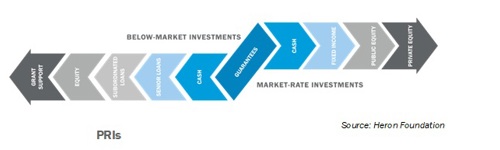
Grants are outright charitable expenditures, made with no expectation of repayment. By contrast, PRIs are structured as loans equity/guarantees, with the expectation—though not the guarantee—of repayment. This allows foundations to potentially recycle capital into future charitable activities.
PRIs are defined under Section 4944 of the Internal Revenue Code and related Treasury Regulations. Per the IRS code, a PRI must meet three requirements:
- Primary Charitable Purpose: The primary purpose of the investment must be to further the foundation’s charitable mission (e.g., relief of poverty, advancement of education, promotion of health, environmental protection) rather than to generate income or appreciate capital.
- No Significant Profit Motive: While financial return is possible, it has to be secondary. Foundations are willing to accept below-market returns or take greater financial risk to achieve social impact.
- No Political or Legislative Purpose: The investment cannot be used to influence legislation or participate in political campaigns.
The Strategy Behind Using PRIs
As patient and flexible forms of capital, a program related investment can be equity or debt financing or can be collateral posted as loan guarantee towards senior capital from a bank. In most cases, the PRI is only part of the total funding, but important in catalyzing larger capital sources.
As a hybrid tool that combines characteristics of both grants and investments, foundations use PRIs to provide capital for purposes that are not well served by either grants alone or market-rate investments.
- Prioritize charitable outcomes over financial performance: Where the primary objective for traditional investments is to maximize risk-adjusted financial returns, PRIs are structured to advance the foundation’s mission first, with the understanding that financial returns may be below market in order to maximize charitable impact.
- For example, the PRI can be a construction loan at an interest rate of 1–3%, provided to a nonprofit community clinic to expand their facility in a scenario where the clinic may not be able to afford a market rate interest loan. Conventional market-based lenders would likely charge higher than market rate interest to compensate for the credit risk associated with a small nonprofit community clinic.
- PRIs are explicitly exempt from the IRS’s “jeopardizing investment” rules. The exemption from this rule gives foundations the ability to make a program related investment in opportunities that the foundation finds worthwhile to further its mission and value, even if the investment involves risk levels that would be inappropriate for a foundation’s endowment.
- As an example, the PRI can be an equity investment in a seed stage clinical research for a rare illness. This could move the research forward to a stage where it gains traction with private equity funders. Conventional venture capital investors may see little prospect in funding research to cure a rare illness that may not have sizeable market demand.
- Align Foundation’s Balance Sheet with Mission: As PRIs are considered investments, they sit on the foundation’s balance sheet, aligning it with the foundation’s mission. For many boards, this reinforces the foundation’s institutional values and strengthens the integrity of the Mission.
- Extend the Foundation’s Reach: PRIs count toward a private foundation’s 5% annual minimum distribution requirement and are used to complement traditional grantmaking.
- A well-structured ladder of PRI loans with staggered maturities can generate incremental capital for philanthropy in addition to the foundation’s normal annual grantmaking.
- PRIs enable the foundation to respond to a broader range of mission-aligned needs that require capital rather than grant support.
-
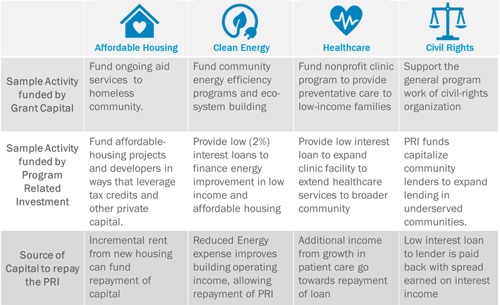
Advance Your Mission in Ways Beyond What is Possible with Just Grants. Grants mostly serve to fund the ongoing activity of a nonprofit whose services align with the mission of a grant-making foundation. PRIs, on the other hand, provide low-cost capital to fund projects with larger capital needs and provide a means for the underlying nonprofit to unlock other sources of capital. The ability to tailor a PRI’s structure to meet the funding requirement of the target project gives the foundation the ability to make an impact in a broad spectrum of circumstances:
- Patient, flexible capital: Certain social challenges—such as affordable housing development, community health infrastructure, or small-business growth in underserved areas—often require patient, flexible capital rather than one-time grants.
- Filling market gaps: By accepting higher risk or lower returns, foundations can help nonprofits pursue projects that might otherwise not proceed if they were to rely only on market participants.
- Catalyze the “crowding in” of other capital to multiply the impact of the foundation’s dollars: Even a modest amount of PRI from a foundation can strengthen the nonprofit’s ability to attract additional funding from banks, impact investors, or public agencies. The PRI can serve as first loss capital, reduce perceived risk, and signal credibility and confidence in the recipient organization. For this reason, PRIs are also called catalytic capital.
The table below illustrates a few examples of where grant funding differs from that of PRIs.
PRIs and Their Tax Treatment
PRIs also receive favorable treatment under federal tax law, which enhances their appeal as a philanthropic tool.
- Count Toward Payout Requirement: PRIs count toward a private foundation’s 5% annual minimum distribution requirement. The capital to make PRIs can come from either the endowment or from the capital that would have gone towards grant making. The latter is a more common practice. It may be 1% of the 5% that is used towards grant making.
- Recycling of Capital: The capital repayment from the PRI counts towards the foundation’s charitable giving dollars. The funds do not count as part of the investment portfolio, which make up the “denominator” to calculate payout requirements for that year. This allows foundations to reuse charitable capital over time without adverse tax consequences.
- Excise Tax on Investment Income: Any return generated by a PRI (such as interest or capital gains) is subject to excise tax on net investment income at the same rate that is applied to the income and gains on the endowment investment portfolio.
Who Can Receive PRIs?
Like grants, eligibility of recipients and investments for PRI funds are shaped by Internal Revenue Code requirements, fiduciary standards, and philanthropic practice, again, with the primary objective that the exempt purpose of the foundation (i.e., its mission) is satisfied. It is not uncommon that recipients of PRIs are entities that have previously received grants from the foundation.
Eligible recipients include:
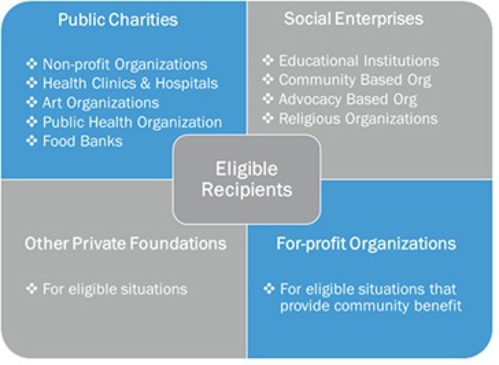
It is possible to provide PRIs to other private foundations, but the investment must advance charitable purposes and include concessionary terms that a regular market investor would not normally accept. Providing capital to for profit organizations may require “expenditure responsibility” to ensure that the foundation’s mission is the primary objective.
PRIs are also advantageous to the non-profits receiving them:
- Credit Enhancement: While many nonprofits are accustomed to grant funding, PRIs can support larger projects by improving financial standing and catalyzing other public and private capital.
- Operational Expansion: PRIs allow the recipient to pursue projects that expand their operations and grow the impact they can make. These projects require capital beyond the grants they receive.
Risks and Concerns:
While PRIs offer meaningful benefits, they also require careful governance and management. Strong policies, due diligence processes, and board oversight are essential to managing these risks effectively.
- Financial Risk: PRIs often involve higher default risk or uncertainty of returns. The nonprofits most in need of PRIs often do not have the credit history and resources to attract capital from market-based funders. Foundations recognize that PRIs offer an impactful option to address complex social challenges and therefore seek to conduct proper due diligence on PRI opportunities.
- If the investment does fail to return capital, then the foundation can categorize the PRI capital as money given away as a grant.
- If the investment does generate an unexpected high return, then the gains can be recycled for further charitable purposes, either as new PRIs or as grants.
- Operational Complexity: PRIs require written investment agreements as well as reporting of clear charitable purpose. Structuring, monitoring, and managing PRIs typically require more staff expertise than traditional grants.
- While financial return is secondary for PRIs, any modest income earned can help offset administrative costs, and any income or gains are subject to the same excise tax treatment as the foundation’s other investments.
- Foundations should do an assessment of their operations and governance structure to determine their desire and capability to build out a PRI program.
- Mission Discipline: Foundations must clearly articulate and document the charitable purpose of each PRI to maintain compliance with IRS rules. There is also additional reporting of financial returns on each PRI on Form 990-PF.
- Liquidity Considerations: PRIs may require capital to be tied up for extended periods, reducing short-term liquidity. Foundations also must proactively source new PRI opportunities to deploy the capital that comes back from maturing PRIs.
- A pacing model can help guide the timing and size of PRIs over time to create a self-funding PRI program that accompany the foundation’s grant making program.
For Further Consideration:
Program Related Investments are a well-established tool that allow foundations to deploy capital in ways that directly advance mission, complement grantmaking, and potentially extend the reach of philanthropic resources. While PRIs require thoughtful governance and risk management, they offer a flexible and impactful option for addressing complex social challenges.
Foundations looking to pursue a PRI program may consider the following initial steps.
- Assess whether it would be beneficial for the foundation to pursue a PRI program.
- Gauge potential interest and support from the Board.
- Present illustrative case studies from peers.
- Develop a draft PRI investment policy and guidelines.
- Assess potential PRI opportunities aligned with the foundation’s mission.
At Canterbury, we focus on our clients’ investments so they can remain focused on their mission. We view program-related investments as a natural extension of a foundation’s philanthropic objectives and are honored to support clients that incorporate PRIs into their giving.
About Canterbury
Canterbury Consulting is an independent investment advisory firm based in Newport Beach, CA, overseeing $58.1 billion in assets as of June 30, 2025. Canterbury provides consulting services to tax-exempt organizations, including community foundations, educational endowments, religious organizations, arts and cultural foundations, and health care organizations, as well as family offices. Founded in 1988, the firm designs and manages custom investment programs aligned with each client's goals. Canterbury acts as the investment office for its diverse clients and provides objective investment advice, asset allocation, manager selection, risk management, implementation, and performance measurement. Named one of the Best Places to Work in Money Management by Pensions & Investments from 2020 through 2025 as well as one of the Best Places to Work in Orange County by the Orange County Business Journal in 2020 through 2025. Canterbury Consulting strives to deliver performance and service that exceeds the needs and expectations of its clients
Ms. Parekh is a shareholder of Canterbury and is an investment consultant advising clients on investment strategy, risk management and portfolio construction. She is a member of the Canterbury Outsourced CIO platform, which caters to institutions and private clients who wish to outsource day-to-day management of their portfolios to Canterbury. She is also a member of each of the firm’s five Manager Research Committees. She joined Canterbury in 1996 as the manager of analytics with responsibility for directing the firm’s account analysts and client services group. In that role, Ms. Parekh secured many of the asset allocation modeling and research software tools we use today. In 2001, she became the director of manager research, responsible for oversight of all manager, fund, and product research; maintenance of Canterbury’s proprietary research database; and chairing the Investment Manager Research Committee. Ms. Parekh graduated from the University of Hong Kong with a Bachelor of Arts in economics. She completed her Master of Business Administration at Shenandoah University.

